Wednesday, December 7, 2011

Water Fights in Dimock

This morning I turned on my tap and filled up my teapot with water from my well. I cooked oatmeal. I washed my face with warm water. And not once did I have to worry about checking the water level in my tanks, rationing bottles for the week’s cooking and wondering whether I could afford to pay for water deliveries next week.
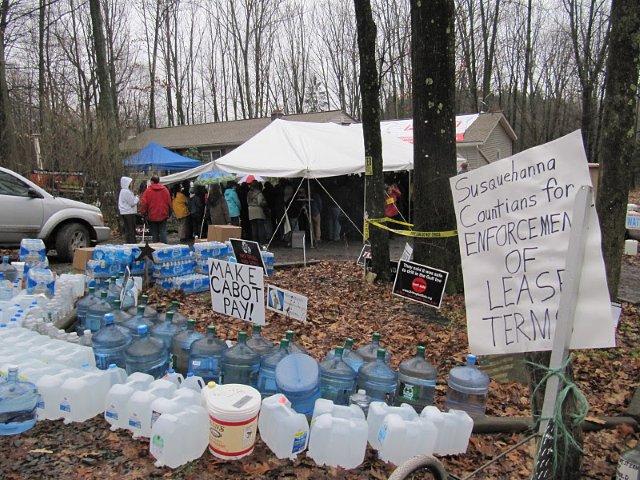
photo by Kathy Cronin, Sierra Club
Drive an hour southeast, just 50 or so miles away, and the story is different. Eleven families in Dimock, PA ration every drop of water they’ve got. Because last week Cabot Oil & Gas cut off water deliveries to their homes. Water deliveries that replaced the well water contaminated by methane migration from leaky well casings in three of Cabot’s wells.

But Cabot, and DEP have decided that now, after three years, the water is “good enough” to drink. It’s not, writes Kate Sinding who characterizes this water as an “alphabet soup of dangerous contaminants, including lead, beryllium, iron, manganese, and non-naturally occurring chemicals associated with fracking such as bis (2-Ethylhexyl) adipate, bis (2- Ethylhexyl) phthalate, and ethylene glycol.” While Cabot has offered to install “whole house methane treatment systems” in the affected homes, but those systems not only don’t target many of the contaminants at issue but, experts say, don’t work in homes with  high iron content in the water – like so many of the homes in Dimock.

NY Assemblywoman Barbara Lifton was outraged by Cabot’s decision to cease water deliveries. “These gas-drilling companies seem to be expert at evading responsibility, and clearly, states seem to have a very hard time holding these companies to account,” she told the press Monday. “The Declaration of Universal Human Rights says that access to clean water is a basic human right, one that has been taken from our neighbors just south of here. It’s a moral outrage and I will continue to work to prevent the terrible situation that the people in Dimock are now experiencing from happening in New Yorkers’ backyards.”

photo by Kathy Cronin, Sierra Club
This Monday and Tuesday good Samaritans delivered water to the Dimock waterless. On Monday the Sierra Club paid to have a truck deliver water from Binghamton. Tuesday saw another truck arrive – this one from NYC, accompanied by celebrities and a hundred volunteers who delivered cases of bottled water and helped top off the plastic tanks lovingly referred to as “water buffaloes”.

The people of Dimock are grateful for the kindness. But this is a temporary fix at best. Cabot broke their dependable groundwater supply and they want Cabot to fix it. Cabot refuses; they insist the water is not contaminated, citing a recent email from EPA stating that water sampling data provided by some of the residents failed to show that contaminant levels exceeded federal drinking water standards.

Apparently that was good enough for DEP and the agency gave Cabot permission to stop paying for the water deliveries. 

The devil is in the details. Although the data does not indicate that the well water presents an immediate health threat to users, Trish Taylor (who works in the EPA’s hazardous site cleanup division in Philadelphia) told the press that EPA is not giving Dimock a clean bill of health.

The agency needs more data, she said. “We have a very finite amount of data that was provided to us by these residents and by DEP. It’s not a broad statement at all about sampling results.”

So, back to the good Samaritans delivering water…. On Monday night Binghamton mayor Matt Ryan offered to supply water to the residents as a temporary measure until they can work out a permanent solution.  But for one municipality to help another requires a mutual aid agreement – something the town councilors of Dimock are adamantly against. Not only that – other residents of Dimock vociferously protested the idea that anyone should be delivering water to their needy neighbors.

Said one Dimock resident, “Those who represented the Enough Already group shouted down everyone who tried to speak in defense of those who do not have water or who tried to explain why they wanted to bring water including Mayor Ryan - and the township supervisors allowed it. They were vile, rude, laughed at them… it was a really despicable performance. I can't believe they would treat their neighbors like that no matter how they felt about them. Why do they care if people want to bring water to them and their children?”

Why indeed. You can see for yourself how they behaved, courtesy of this video posted by Energy in Depth

To read past posts on this issue just click on the Dimock label over in the right-hand column.

Friday, December 2, 2011

Can DEC adequately monitor NYS drilling?

Used with permission


One of the things DEC stresses in its newest edition of the draft SGEIS is that the well casings will protect our water from any contamination.

OK, but folks who find old wells wonder just how committed DEC is to keeping that promise. After all, there’s loads of wells across the state that haven’t been properly plugged and abandoned.

Back in 1984 Chesapeake drilled this well into the Queenston formation in the town of Sennett, NY just east of Auburn. DEC has been notified that this well should be plugged and abandoned. But the question remains: why did the DEC and Chesapeake allow the condition of this well to degrade to this extent? And how many more wells are out there like this?

The person who sent me this photo has asked DEC for more information about whether and how this well has been abandoned, and what sort of testing – above and below ground- has been done.
He’s also posted a full DEC file on this well – photographs he took at the Avon DEC office. You can see more photos and documents at http://freepages.genealogy.rootsweb.ancestry.com/~springport/pictures385/potter_web/

Wednesday, November 30, 2011

DEC Extends Fracking Comment Period

New Yorkers have an additional thirty days to prepare comments on high-volume horizontal hydraulic fracturing. At the outset of today’s DEC hearing in New York City – the fourth and final public hearing – a DEC spokesperson announced that the deadline for public comment has been extended an additional month, until January 11. The decision came in response to numerous requests from environmental groups and others who wanted more time to sort through the humongous 1500-page environmental impact study and the proposed rules.

Read the proposed regulations at http://www.dec.ny.gov/regulations/77353.html
Submit comments:
By mail to Attn: dSGEIS Comments; New York State Department of Environmental Conservation; 625 Broadway; Albany, NY 12233-6510

Tuesday, November 29, 2011

Some Fracking Humor

used with permission of artist, Russeau
My friend, an artist, cartoonist and all around excellent person, has been doodling weekly gas-field humor for the Broader View Weekly (Chemung & Tioga Counties, NY) for the past couple years or more. Every now and then he lets me post 'em.

Thursday, November 24, 2011

Gas Leases Conflict with Mortgage Rules

well pad construction behind home in Towanda, PA
According to attorney Elisabeth Radow, gas leases conflict with home mortgage rules. One problem: hydraulic fracturing for shale gas carries heavy industrialized risks, and those risks can spread with a ripple effect through residential communities.

 “A growing number of banks won’t give new mortgage loans on homes with gas leases because they don’t meet secondary mortgage market guidelines,” says Radow. Mortgages prohibit the storage, use, disposal or release of hazardous substances (including gas) on the mortgaged property. They also prohibit landowners from transferring an interest in the property, such as mineral or gas rights, without the written consent of the mortgage lender.

During a recent phone conversation, Radow delved into the messy conflicts between gas leases and mortgage rules. The main problem she sees is that a gas lease redistributes traditional rights of homeownership to the gas company.

“But not the responsibilities,” Radow emphasizes. One of the responsibilities that falls on the landowner is liability. That’s because the industry has not fully insured their operations, she notes. And it’s not clear whether the companies have funds reserved to self-insure to make up for a shortfall in insurance coverage.

In disclosure statements filed with the SEC, both Chesapeake Energy and Range Resources state that drilling is inherently risky; drilling operations can result in injury, loss of life, damage or destruction to property and environmental clean-up. But, they caution, their insurance may not cover all those risks.

In the Form 10-K included with its 2010 Annual Report, Chesapeake reported that it has $400 million in general liability insurance, Radow said. While they have interests in 45,800 productive wells, they control drilling on 25,700 of those wells – that’s about $15,500 in liability coverage for each well they’re drilling. On top of that they carry $75 million for sudden risks, such as blow-outs and $130 million for pollution liability insurance.

“But,” says Radow, “from what appears to be the current practice, the amount of liability insurance gas companies carry may be potentially inadequate for even one catastrophic event. Consider the costs associated with BP and the recent upstate flooding.”

What does this have to do with mortgages? We have a $6.7 trillion secondary mortgage market, Radow said.  As shale gas extraction takes hold nationwide, if the gas company passes the liability from drilling accidents onto the homeowner and the homeowner defaults on his loan, and pension plans and others investment vehicles have invested in the secondary mortgage market ….  “I see potential for another serious secondary mortgage market impact,” Radow said.

Bubble or no, there are other potential financial problems with gas leases on residential properties. Recent data show that the value of homes and property near wells is declining. If the assessed value of a property goes down, that property’s taxes could follow suit. On a municipal-wise basis, decreases in the assessed value of homes near drill sites could affect the rest of the town by increasing what they pay to make up for that loss in tax revenue. Even people who don’t lease to gas companies could find their finances adversely affected by drilling on their neighbor’s property, Radow said.

“We are all in this together,” says Radow, noting that tens of thousands of New Yorkers have signed gas leases. “While New Yorkers hope to reap royalties from their underground shale gas, on the expense side we haven’t an inkling of how it will all shake out.”

You can read the longer, print edition of this article at Tompkins Weekly.

For a more detailed study of this issue read Radow’s article, “Homeowners and Gas Drilling Leases: Boon or Bust” in the Nov/Dec 2011 issue of NYSBA Journal.