Tuesday, December 20, 2011

A Taxing Question...

In an email to the local press yesterday, Department of Environmental Conservation (DEC) spokeswoman Emily DeSantis remarked on the agency’s need for additional funds for regulating hydraulic fracturing and gas drilling. Apparently those funds “will not be included in the executive budget” – the budget Gov. Andrew Cuomo will propose around mid-January.

That’s about the same time that DEC should be getting down to the business of reading through the thousands of public comments regarding the draft Supplemental Generic Environmental Impact Statement (SGEIS). And the proposed regulations for high-volume horizontal hydraulic fracturing.

Wayne Bayer, a DEC engineer who is shop steward for the Public Employees Federation union, said the agency is understaffed and its employees are concerned about adding a new regulatory program like hydrofracking.

At this point the DEC estimates it will need 140 new workers for the first year permits are issued and 226 by the fifth. Add salaries to the cost of needed equipment and you’re looking at an additional $20 million a year.

Where will that money come from? Right now DEC has convened a panel of outside experts to develop a list of fees and taxes that could be levied on drillers to cover the costs. That panel should be issuing a report “sometime in the first part of next year,” says DeSantis.

But it’s going to be tough to sell the need for additional staff when Cuomo has already required all state agencies to cut 10 percent from their budgets for the current fiscal year, and is looking for an additional 2.5 percent cut for 2012-13.

What to do? Ask the industry to pay for the services it uses. Jim Smith, a spokesman for the Independent Oil & Gas Association of New York (IOGA-NY), is confident the money will come into the state once DEC gives drillers a green light. “We support more DEC staff,” he told the press. Once drilling starts there should be enough revenue through permitting and other fees to “more than pay for that staff.”

Friday, December 16, 2011

What Fracking Sounds Like

One of the things that residents in NY have been asking their towns to do before Marcellus drilling takes off is develop some noise and light ordinances. In fact, Tioga Investigates Natural Gas (TING), an advisory group in Tioga County, NY includes information on developing such ordinances in their resource binder (along with road agreements and lots of other useful stuff).

If you have never seen - or heard or smelled - fracking, here's a video of  a fracking operation by Williams Gas Company at the Hollenbeck well site on Franklin Forks Rd., Franklin Forks, PA in Susquehanna County. The video was recorded on December 15 - just yesterday - at 6:30 pm. The active drilling site is across the road from a home; pay attention to the truck traffic.

Much thanks to Vera Scroggins, Citizens for Clean Water (Susquehanna County, PA)for the video.
If for some reason the video below doesn't work, here's the link:  http://youtu.be/zPE2RU5099U


Wednesday, December 14, 2011

DEC Environmental Engineer says Fracking WILL Pollute Water

Paul Hetzler, an environmental engineering technician with NYS Department of Environmental Conservation (DEC) Region 5 says hydraulic fracturing – as it’s practiced today – will contaminate our aquifers. Not might. Will.

In  a letter to the Watertown Daily Times Hetzler criticizes current technology. “If you were looking for a way to poison the drinking water supply, here in the Northeast you couldn’t find a more chillingly effective and thorough method of doing so than with hydraulic fracturing,” he writes. “There’s no such thing as a perfect well seal. Occasionally sooner, often later, well seals can and do fail, period.”

And that failure, when it happens, will be expensive. Everyone, regardless of whether they are receiving royalties or living miles away, will end up paying for the subsurface investigations, whole-house filtration systems and unending lab analyses as industry lawyers tie up complaints in courts.

“I’d love to see hundreds more jobs created,” Hetzler writes. “But not if it means hundreds of thousands using well water will be at a high risk of contamination.” The solution? Develop safe technologies before drilling.

Hetzler isn’t the only DEC staffer to speak out against the agency’s current – and proposed – fracking regulations. At the November 30 DEC hearing in New York City Stephanie Low read a statement from DEC employee Wayne Bayer. Bayer is an Environmental Program Specialist and Executive Board member of the DE’'s union, the Public Employees Federation (PEF). He speaks for the 1774 members of the professional, technical and scientific staff of the DEC – those on the ground, he says, who know the issues of fracking and the draft SGEIS best.

“The 25 percent  reduction in existing staff at DEC has crippled our ability to carry out all existing regulatory and statutory responsibilities assigned to our agency,” Bayer states. “There is no fracking way we can presently, honestly and adequately add any new responsibility as labor-intensive as regulating, monitoring and inspection activities related to high volume hydraulic fracturing of natural gas.” Until DEC can hire adequate staff … “the moratorium should be extended.” You can hear the entire statement here.

Tuesday, December 13, 2011

Judge to Dimock: No Soup for You


Last Friday Pennsylvania Environmental Hearing Board Judge Bernard Labuskes Jr. told the Carter Road residents that they would not see future water deliveries. At least not until they have allowed Cabot Oil & Gas to install “whole-house gas mitigation” systems for their wells.

When the water shipments were canceled twelve days ago, the 11 families depending on delivered water appealed to the PA Environmental Hearing Board. They argue that the state is wrong in ignoring the harm that could come from drinking contaminated water. It’s more than methane, say the Carter road residents. Their water contains metals and volatile organic compounds including solvents and manufactured chemicals at levels higher than state and federal standards.

Of course, Cabot and the PA Department of Environmental Protection (DEP) submitted their own arguments, noting that the Environmental Hearing board doesn’t have the authority to force the driller to continue deliveries of drinking water. Nor does it have the authority to order DEP to take enforcement action.

So where does that leave the Carter road folks? With empty water tanks. Because, as some of them have told the press, the treatment system Cabot is offering only targets methane, not the other toxic contaminants. And what they want – despite the political bickering and nasty comments from the “Enough Already” crown – is their water back. They want good, clean water to drink – or make soup. Not a wad of cash.

Wednesday, December 7, 2011

Water Fights in Dimock

This morning I turned on my tap and filled up my teapot with water from my well. I cooked oatmeal. I washed my face with warm water. And not once did I have to worry about checking the water level in my tanks, rationing bottles for the week’s cooking and wondering whether I could afford to pay for water deliveries next week.

photo by Kathy Cronin, Sierra Club
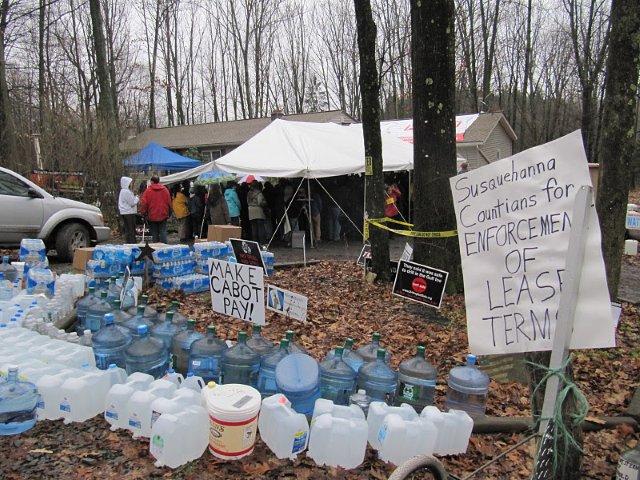
Drive an hour southeast, just 50 or so miles away, and the story is different. Eleven families in Dimock, PA ration every drop of water they’ve got. Because last week Cabot Oil & Gas cut off water deliveries to their homes. Water deliveries that replaced the well water contaminated by methane migration from leaky well casings in three of Cabot’s wells.

But Cabot, and DEP have decided that now, after three years, the water is “good enough” to drink. It’s not, writes Kate Sinding who characterizes this water as an “alphabet soup of dangerous contaminants, including lead, beryllium, iron, manganese, and non-naturally occurring chemicals associated with fracking such as bis (2-Ethylhexyl) adipate, bis (2- Ethylhexyl) phthalate, and ethylene glycol.” While Cabot has offered to install “whole house methane treatment systems” in the affected homes, but those systems not only don’t target many of the contaminants at issue but, experts say, don’t work in homes with  high iron content in the water – like so many of the homes in Dimock.

NY Assemblywoman Barbara Lifton was outraged by Cabot’s decision to cease water deliveries. “These gas-drilling companies seem to be expert at evading responsibility, and clearly, states seem to have a very hard time holding these companies to account,” she told the press Monday. “The Declaration of Universal Human Rights says that access to clean water is a basic human right, one that has been taken from our neighbors just south of here. It’s a moral outrage and I will continue to work to prevent the terrible situation that the people in Dimock are now experiencing from happening in New Yorkers’ backyards.”

photo by Kathy Cronin, Sierra Club
This Monday and Tuesday good Samaritans delivered water to the Dimock waterless. On Monday the Sierra Club paid to have a truck deliver water from Binghamton. Tuesday saw another truck arrive – this one from NYC, accompanied by celebrities and a hundred volunteers who delivered cases of bottled water and helped top off the plastic tanks lovingly referred to as “water buffaloes”.

The people of Dimock are grateful for the kindness. But this is a temporary fix at best. Cabot broke their dependable groundwater supply and they want Cabot to fix it. Cabot refuses; they insist the water is not contaminated, citing a recent email from EPA stating that water sampling data provided by some of the residents failed to show that contaminant levels exceeded federal drinking water standards.

Apparently that was good enough for DEP and the agency gave Cabot permission to stop paying for the water deliveries. 

The devil is in the details. Although the data does not indicate that the well water presents an immediate health threat to users, Trish Taylor (who works in the EPA’s hazardous site cleanup division in Philadelphia) told the press that EPA is not giving Dimock a clean bill of health.

The agency needs more data, she said. “We have a very finite amount of data that was provided to us by these residents and by DEP. It’s not a broad statement at all about sampling results.”

So, back to the good Samaritans delivering water…. On Monday night Binghamton mayor Matt Ryan offered to supply water to the residents as a temporary measure until they can work out a permanent solution.  But for one municipality to help another requires a mutual aid agreement – something the town councilors of Dimock are adamantly against. Not only that – other residents of Dimock vociferously protested the idea that anyone should be delivering water to their needy neighbors.

Said one Dimock resident, “Those who represented the Enough Already group shouted down everyone who tried to speak in defense of those who do not have water or who tried to explain why they wanted to bring water including Mayor Ryan - and the township supervisors allowed it. They were vile, rude, laughed at them… it was a really despicable performance. I can't believe they would treat their neighbors like that no matter how they felt about them. Why do they care if people want to bring water to them and their children?”

Why indeed. You can see for yourself how they behaved, courtesy of this video posted by Energy in Depth

To read past posts on this issue just click on the Dimock label over in the right-hand column.